Case study · 2026
Colloxa
A product narrative and homepage structure that make governance feel operational, with clear trust sections and a conversion pathway for enterprise evaluation.
View live site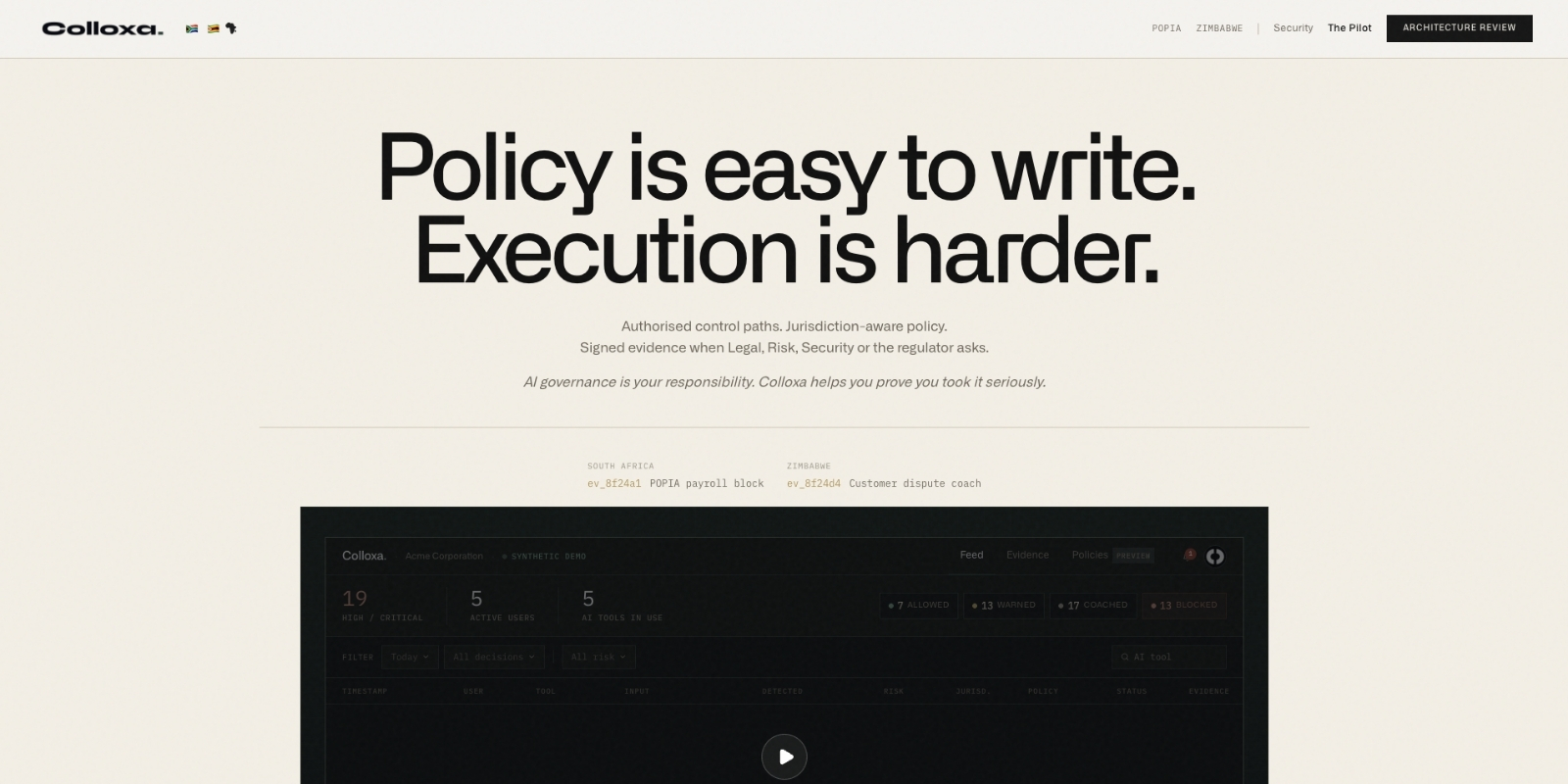
01 / Context
The brief was operational, not cosmetic.
The problem
A complex AI governance platform needed to feel credible, precise and built for regulated enterprises.
The intervention
Product narrative, homepage structure, trust and enforcement sections, legal pathways and a conversion route aimed at regulated financial services buyers.
02 / System
Structure the work behind the surface.
Site architecture organised around enforcement, evidence and operational trust — POPIA, NDPR and Kenya DPA obligations framed as product behaviour, not footnote compliance.
A product narrative and homepage structure that make governance feel operational, with clear trust sections and a conversion pathway for enterprise evaluation.
03 / Decisions
Constraints shaped the system.
Constraints
- Buyers in regulated financial services need precision; vague “AI for Africa” language erodes trust immediately.
- Governance claims must map to recognisable obligations — POPIA, NDPR, Kenya DPA — without turning the homepage into a statute.
- The product is infrastructure; the site has to explain enforcement and evidence without drowning visitors in architecture diagrams.
- Conversion must support evaluation, not only awareness — credibility precedes a demo request.
Trade-offs
- Led with enforcement, evidence and operational trust instead of generic AI spectacle or feature grids.
- Used regulatory frameworks as narrative anchors rather than burying them in a legal footer.
- Kept depth in structured sections so the homepage stays scannable while still surviving a compliance-minded reader.
04 / Evidence
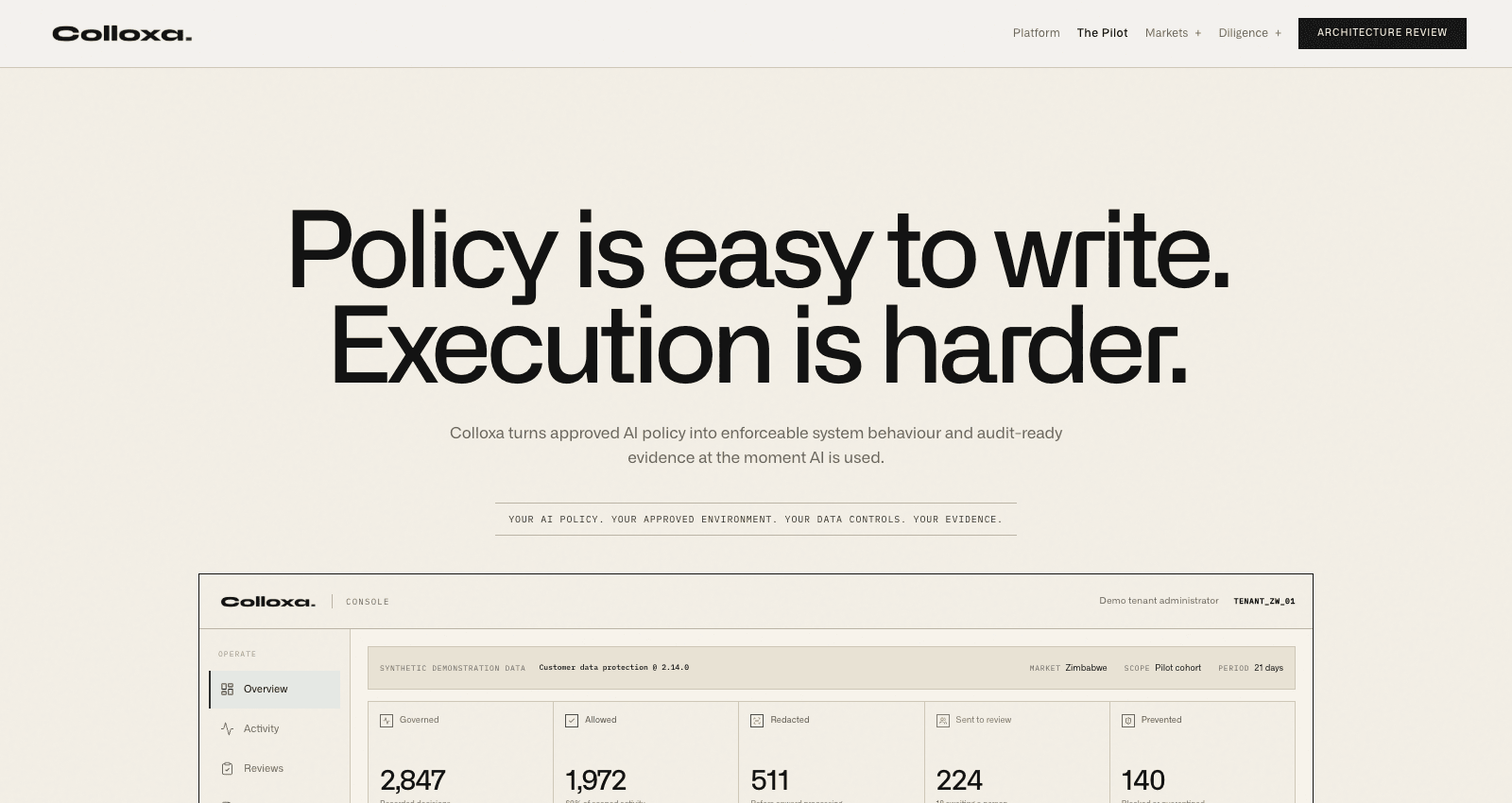
Selected screen
05 / Readout
How the work moves.
The operational problem
Colloxa is Africa-first AI governance and privacy infrastructure for regulated financial services. The website problem was not “look modern.” It was making a dense, high-stakes product feel precise and credible — so an enterprise buyer could see enforcement, evidence and regional obligations as the product itself, not as marketing decoration.
Design and systems reasoning
The site was structured around how regulated buyers evaluate risk: what is enforced, what evidence exists, and how obligations in POPIA, NDPR and Kenya DPA show up in real time. Narrative order follows that evaluation path — problem and stakes, product behaviour, proof and trust, then a clear next step — instead of a generic SaaS ladder of features → benefits → pricing.
Legal and trust pathways are part of the information architecture, not an afterthought page. The homepage has to survive a compliance-minded skim without collapsing into slogan language.
Workflow / architecture of the story
- Stakes — why governance infrastructure matters for African financial services.
- Behaviour — enforcement and evidence as product verbs, not abstract principles.
- Obligations — POPIA, NDPR and Kenya DPA as recognisable frames.
- Trust — proof sections and legal pathways that support due diligence.
- Route — conversion aimed at evaluation and conversation, not empty lead capture.
Before → after
Before: A complex AI governance offer risked reading like generic AI marketing — impressive vocabulary, weak operational signal.
After: Product narrative and homepage structure organised around enforcement, evidence and trust, with a clear route into architecture review and pilot evaluation.
Observable outcome
Shipped: product narrative, homepage structure, governance and trust sections, legal pathways and an enterprise-facing conversion route. The site makes Colloxa feel like infrastructure for regulated work — not a pitch deck rendered as HTML.